

The Art of Active Listening: Why Truly Hearing Someone Can Change Everything
Are You Listening — or Just Waiting to Talk?
There's a difference between hearing someone and truly listening to them. Most of us have been in a conversation where we felt completely unheard — where the other person's eyes glazed over, their phone lit up, or their response made it clear they'd already mentally moved on. It's an isolating feeling.
Now think about the flip side: a moment when someone sat with you, gave you their full attention, and made you feel genuinely understood. That experience is rare — and it's powerful.
Active listening is the skill that creates that experience. It's not just a "nice to have" in professional development workshops. In the right moment, it can be the difference between someone feeling supported or feeling completely alone — particularly when the conversation touches on mental health.
What Is Active Listening?
Active listening is a communication technique that goes beyond simply hearing the words someone says. It involves being fully present, engaging with both the verbal and non-verbal cues of the speaker, and responding in a way that shows genuine understanding and empathy.
Unlike passive listening — where you're physically present but mentally elsewhere — active listening requires conscious effort and intention. It means putting aside your own agenda, judgements, and the urge to problem-solve, so the other person feels truly seen and heard.
Psychologist Carl Rogers, who pioneered person-centred therapy, described this as "listening with understanding" — entering the other person's world without losing yourself in it.
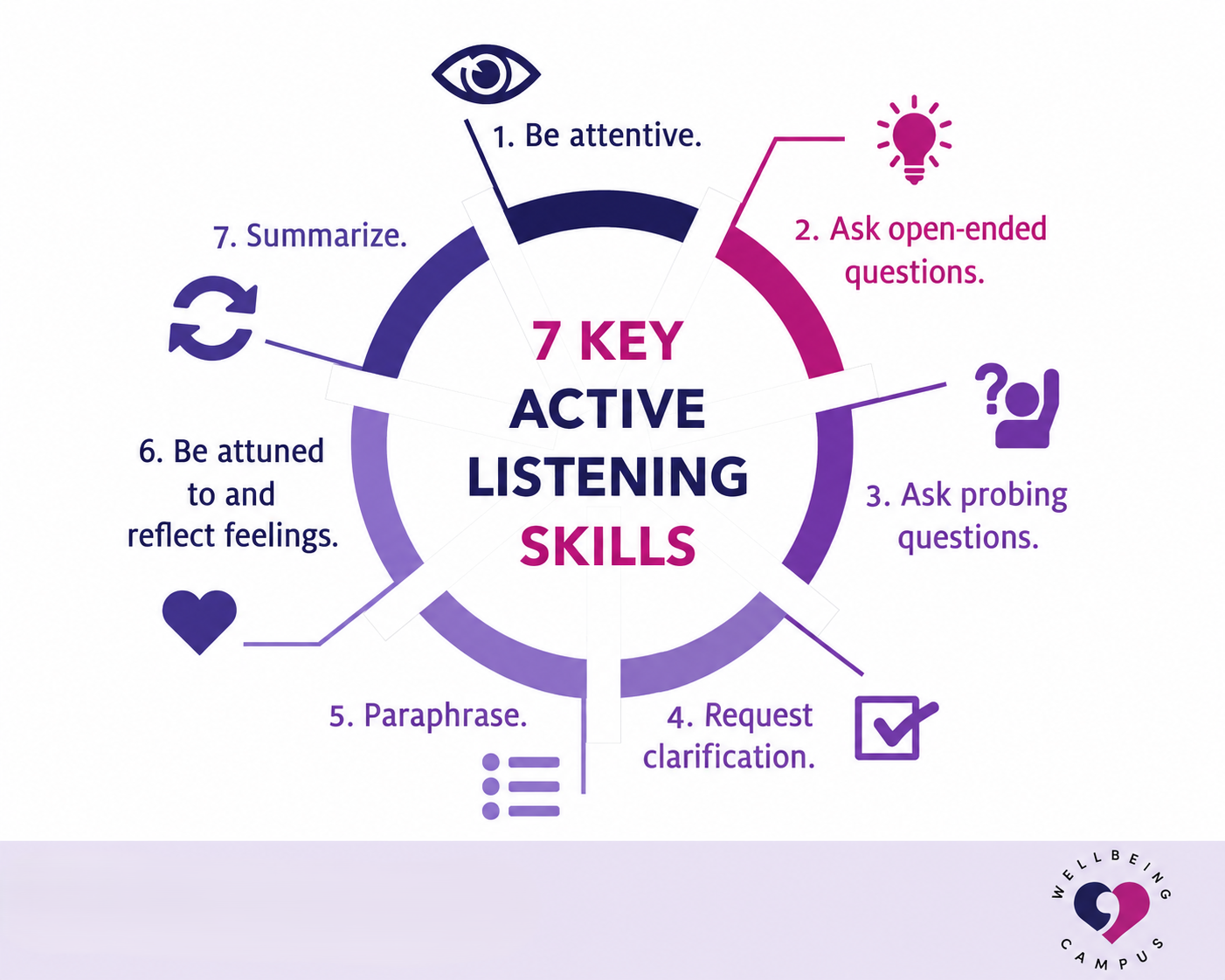
The Core Skills of Active Listening
Becoming a better active listener doesn't happen overnight, but these foundational skills can be developed with practice.
1. Give Your Full Attention
Put down your phone. Step away from your computer. Make eye contact (without staring intensely). Your body language communicates volumes before you say a single word. Facing the person, uncrossing your arms, and nodding occasionally all signal: I am here, and you matter.
2. Don't Interrupt
This one sounds simple, but it's surprisingly hard. Our brains process information faster than people speak, which means we're often already forming a response before someone has finished their thought. Resist that urge. Let them complete what they're saying — silences included. Silence is not a gap to be filled; it's often where the most important things emerge.
3. Reflect Back What You Hear
Paraphrasing or summarising what someone has shared shows you've actually absorbed their words. Phrases like "So it sounds like you're feeling..." or "What I'm hearing is..." are not just techniques — they give the speaker a chance to clarify or go deeper. They also communicate that their experience matters enough for you to try to understand it accurately.
4. Ask Open-Ended Questions
Rather than questions that invite a yes or no, ask questions that open a door. "How did that make you feel?" or "What's been the hardest part of that for you?" invite the speaker to explore their own experience more fully. This is especially important in mental health conversations, where the person may still be making sense of what they're going through.
5. Acknowledge Feelings Without Judgement
Validation doesn't mean agreement — it means recognising that someone's feelings are real and understandable. Saying "That sounds incredibly difficult" or "I can understand why you'd feel that way" creates psychological safety. People are far more likely to open up when they don't fear being judged or dismissed.
6. Watch for Non-Verbal Cues
Communication is more than words. Pay attention to tone of voice, posture, facial expressions, and what isn't being said. Someone might say "I'm fine" while their voice cracks. Noticing this — and gently naming it — can open a conversation that someone desperately needed to have.
7. Manage Your Own Reactions
Active listening requires self-awareness. If what someone shares triggers a strong emotional reaction in you, notice it — and set it aside for the moment. Your job in that conversation is not to process your own feelings, but to hold space for theirs. This is a skill, not a suppression; you can return to your own experience later.
Why Active Listening Matters in the Workplace
Workplaces are made up of people — and people bring their whole selves to work, whether we acknowledge that or not. Stress, burnout, conflict, and disengagement are all deeply human problems, and they're all influenced by the quality of communication in an organisation.
When managers and colleagues practise active listening, several things happen:
Trust deepens. People who feel heard are more likely to be honest, raise concerns early, and engage authentically. This creates a culture where problems surface before they escalate.
Conflict reduces. Many workplace conflicts stem from misunderstandings and people feeling dismissed. Active listening breaks that cycle — it slows a conversation down enough to actually understand what the other person means, not just what you think they mean.
Productivity improves. When people feel psychologically safe, they contribute more freely. Ideas flow, collaboration strengthens, and individuals feel invested in shared outcomes rather than just protecting themselves.
Mental health is better supported. One in five Australians will experience a mental health condition in any given year. Managers are often the first point of contact when someone is struggling. A leader who listens well — without jumping to solutions or minimising — can be the reason someone seeks help rather than suffers in silence.
Active listening is not therapy, and it's important to know the limits of your role. But it can be the bridge that gets someone to the support they need.
Active Listening in the Community: The Ripple Effect
It's not only in formal settings that active listening changes lives. In community spaces — whether that's a neighbourhood, a sports club, a faith community, or a support group — the quality of how we listen to one another shapes the fabric of connection.
Loneliness is one of the most pressing public health issues of our time. Studies consistently link social isolation to poorer mental and physical health outcomes. And yet, loneliness is not simply about being alone — it's about feeling unseen and unheard, even in the company of others.
Communities where people practise active listening naturally become safer spaces. People who are struggling feel less afraid to speak up. Those who are marginalised or different feel less invisible. Conversations that might otherwise stay surface-level have the chance to go somewhere real.
This is especially important when it comes to mental health stigma. When someone musters the courage to say "I've been really struggling lately," the response they receive shapes whether they ever say it again. An active listener — one who responds with curiosity, warmth, and no rush to fix — plants a seed of courage in that person. A dismissive response buries it.
Active Listening and Mental Health: Why It's So Critical
Mental health conversations are uniquely vulnerable. When someone shares that they are anxious, depressed, grieving, or overwhelmed, they are doing something that takes enormous courage. They are trusting you with something tender.
What they need most in that moment is usually not advice, not a silver lining, and not a comparison to someone else's harder story. They need to feel that what they are going through is real, it matters, and they are not alone in it.
Active listening provides exactly that. Research in clinical psychology consistently shows that feeling understood is itself therapeutic — it reduces distress, builds resilience, and strengthens the sense of connection that protects mental health.
Some things to avoid in mental health conversations:
Rushing to fix it. "Have you tried exercise?" or "You just need to stay positive" — even well-intentioned — can feel dismissive.
Comparing suffering. "At least you don't have it as bad as..." minimises rather than validates.
Making it about you. "I know exactly how you feel — when I went through X..." can redirect the conversation away from the person who needs to be heard.
Offering unsolicited advice. Unless someone asks for your opinion or solutions, hold off. Ask instead: "Would it help to talk through some options, or do you just need to vent right now?"
And if someone shares something that concerns you — if they hint at hopelessness or self-harm — don't be afraid to ask directly and calmly. "Are you having thoughts of hurting yourself?" is a question that can save a life. Asking it does not plant the idea; it opens a door.
Simple Phrases That Reflect Active Listening
Sometimes knowing what to say is the hardest part. Here are some genuine phrases that communicate presence and care:
"I'm really glad you told me this."
"That sounds really hard. How long have you been feeling this way?"
"I'm not going anywhere — take your time."
"You don't have to have it all figured out."
"What would feel most helpful right now — to talk it through, or just to have someone listen?"
"That makes complete sense, given everything you've been carrying."
These are not scripts to recite — they are invitations. Said with sincerity, they transform a conversation.
How to Start Practising Active Listening Today
Like any skill, active listening improves with deliberate practice. A few ways to begin:
In your next conversation, notice your urge to respond. Just observe it. You don't have to act on it immediately. Let the other person finish — fully — before you speak.
Check in on someone this week. Not with a quick "How are you going?" as you pass in the corridor, but a genuine "Hey, I've got a few minutes — how are you really doing?" And then listen to the answer.
Reflect after conversations. Ask yourself: Did I spend more time listening or speaking? Did I ask questions or give answers? Did the other person seem to feel understood?
Seek feedback. Ask someone you trust: "Do you feel like I really listen to you?" Their answer might surprise you.
The Most Human Thing You Can Do
Active listening doesn't require a psychology degree, a formal setting, or hours of time. It requires a willingness to slow down, set yourself aside for a moment, and make another person feel that their words — and their world — genuinely matter to you.
In the workplace, it builds trust and psychological safety. In communities, it dissolves isolation. In mental health conversations, it can be the moment that changes everything.
So the next time someone starts to speak, ask yourself: Am I actually listening?
And then — truly — listen.
If you or someone you know is struggling with mental health, please reach out to a professional. In Australia, you can contact Beyond Blue on 1300 22 4636, Lifeline on 13 11 14, or speak with your GP.
Tags: active listening, mental health, workplace wellbeing, communication skills, emotional intelligence, community connection, supportive conversations, psychological safety